

NYCxDESIGN 2026: Frame in Frame – Swiss Design in Motion with Daan Couzijn
Intro: Frame in Frame – Swiss Design in Motion
Frame in Frame, curated by Christian Herren, presents rediscovered Swiss structural films from the 1960s–90s. Vivid works unfold across multiple projections at WSA within a spatial installation by Ben Ganz, Panter&Tourron, and Daan Couzijn, featuring furniture by Vitra, USM, Ruckstuhl, and Lehni x ZHdK. Presented by the Swiss Consulate.
Festival: NYCxDESIGN 2026
Event Name: Frame in Frame – Swiss Design in Motion
Dates: May 15–20, 2026 (Opening event evening of May 14)
Hours: Open daily, 12:00–7:00 PM
Edition: Third consecutive edition of Switzerland’s presentation at NYCxDESIGN
Presented by: Consulate General of Switzerland in New York
Curated by: Christian Herren (*1992)
Location: WSA, 19th Floor, 161 Water St, New York City, NY, USA
Website with full program: frameinframe.nyc
-
For the first time in the United States, Frame in Frame – Swiss Design in Motion presents rediscovered experimental films from the 1960s–90s. Shown during NYCxDesign at WSA, the exhibition unfolds within a spatial installation by a new generation of designers. Curated by Christian Herren, the project is presented by the Consulate General of Switzerland.
Rather than presenting film from a fixed position, the exhibition takes shape as an environment structured by furniture, projection, light, and sound. Designer Ben Ganz transforms the iconic Lehni aluminum shelving system into a sculptural projection structure, drawing on a recent collaboration at the Zurich University of the Arts (ZHdK). Design studio Panter&Tourron introduces a flexible cinema landscape with their modular “Anagram” sofa system for Vitra, a reconfigurable platform shifting from focused viewing to informal settings. A bar built from USM Haller elements extends the setting into a place of exchange, while a rug by Trix and Robert Haussmann, produced by Ruckstuhl, introduces a more expressive register.
Within this environment, artist Daan Couzijn activates more than 200 films through a multi-channel video and audio installation, orchestrating their interplay across freestanding screens. The result is a fluid composition where visuals and rhythms form a dynamic interplay of image and sound. More than an archival display, Frame in Frame turns film into a spatial experience that invites movement and interaction.
The films originate from the influential Film + Design course at the Basel School of Design, founded by Armin Hofmann, a central figure of the Swiss Style. Known for its clarity and grid-based organization, this approach also informed Swiss product design through its focus on construction and modular thinking. In Basel, these principles were applied as early as in the 1960s to moving images in response to a visual culture shaped by television and emerging electronic media. Rather than narrative, the structural films focus on the frame and its organization in time – simple rules generate a rich visual language. American art- and design icons such as Marlene McCarty and Philip Burton were drawn to study in Basel and are represented in the exhibition.
In an age where computational tools increasingly automate the creation of moving images, Frame in Frame refocuses attention on the foundational principles behind how films are made. Rooted in the Swiss Design approach, this lineage extends into the present, where a new generation of product designers develops these principles in response to contemporary conditions, opening a view onto the structures that shape what we see.
PRESS RELEASE
FRAME IN FRAME
SWISS DESIGN IN MOTION
New York, NY — April 1, 2026 | Frame in Frame – Swiss Design in Motion stages a large-scale installation by contemporary designers and artists, bringing together Swiss design with a selection of structural and experimental films produced in Switzerland between the 1960s and 1990s. Curated by Christian Herren and presented by the Consulate General of Switzerland in New York, the exhibition is on view during NYCxDesign 2026 at WSA in Lower Manhattan, with the films showing for the first time in the United States. The exhibition scenography is defined by late modernist Swiss furniture systems and contemporary designs that extend their principles of construction and reconfiguration. Developed in collaboration with Panter&Tourron and Ben Ganz, the setting integrates pieces from USM Modular Furniture, Vitra, Ruckstuhl, and Lehni. At the heart of the installation, artist Daan Couzijn orchestrates over 200 rediscovered films from the Film + Design course at the Basel School of Design, initiated by Armin Hofmann and later led by Peter von Arx. These recently digitized works are projected across multiple surfaces to create a unique experience of film and design.
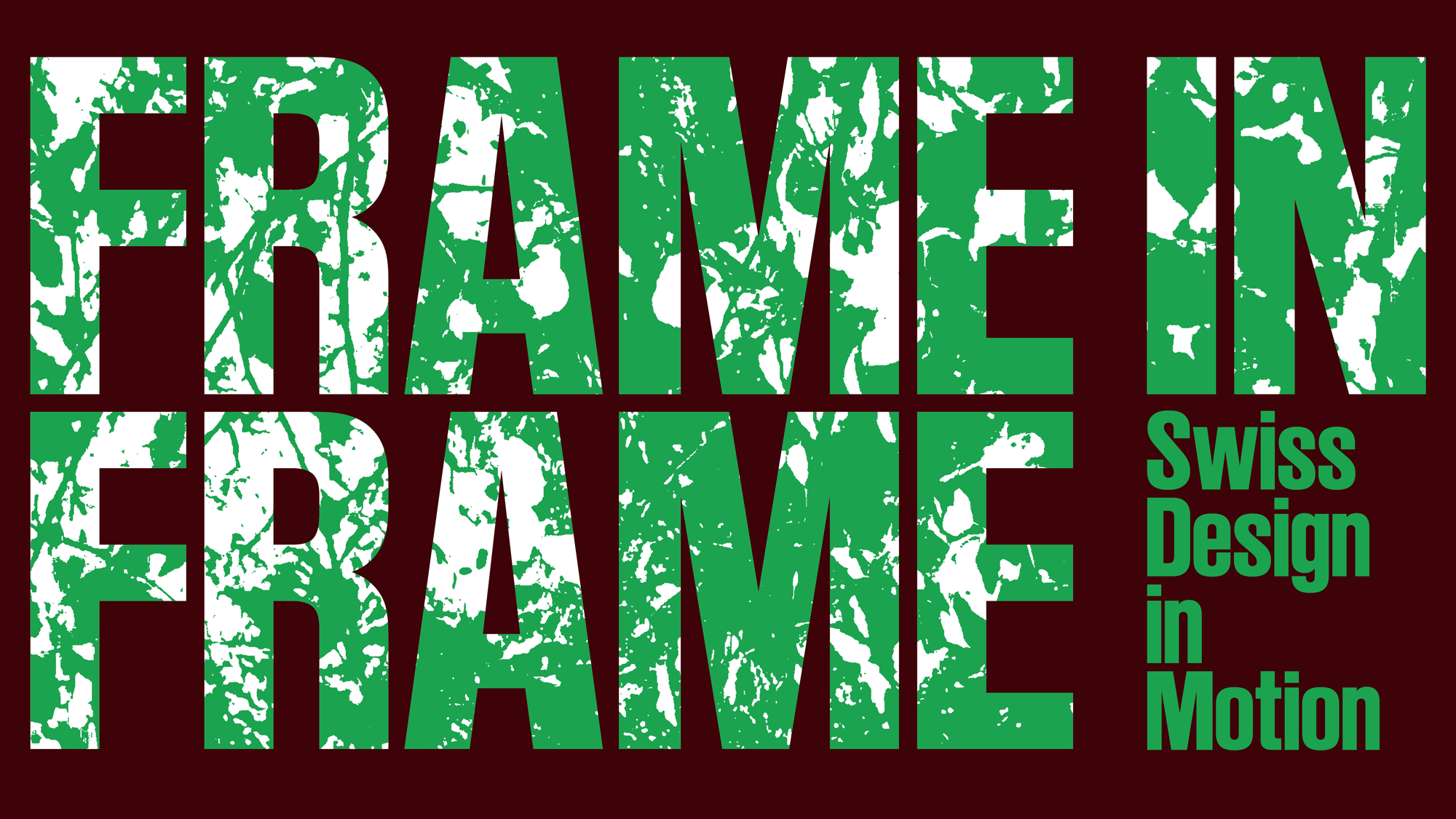
The exhibition’s visual identity by Brooklyn-based Swiss designer Julia Schäfer draws on Swiss Style typography and the presented structural films, reworking their use of sequence and repetition into both static and animated graphic forms. SWISS DESIGN ON FILM Internationally, Swiss design is closely associated with clarity and grid-based structure – characteristics often described as the Swiss Style. At the Basel School of Design, these principles were applied to
moving image in the Film + Design course, conceived within graphic design rather than cinema, offering an unusually early exploration of screen-based communication. Developed at a time when television and emerging electronic media were reshaping visual culture, Film + Design anticipated key disciplines of what is now known as motion design. In the legendary course, students explored the structural properties of film itself. The results range from typographic sequences to rhythmic abstractions and layered compositions. Often accompanied by inventive sound compositions, these films emerge from the same analytical approach that shaped the canonic graphic form of the Swiss Style and demonstrate how disciplined structure could coexist with playful experimentation. The course attracted students from across the globe, including the United States. Among them were Marlene McCarty, later part of the New York collective Gran Fury, and Philip Burton, Professor Emeritus of Graphic Design at the University of Illinois Chicago. Recently restored and digitized at the Basel Academy of Art and Design, the films form a unique archival collection and the conceptual core of Frame in Frame.
FROM ARCHIVE TO INSTALLATION
Rendering of an installation study for Frame in Frame – Swiss Design in Motion: Ben Ganz reconfigures Andreas Christen’s Lehni aluminum system into a pentagonal structure serving as projection surface and spatial framework. Rendering by Alex Nguyen.
The exhibition, Frame in Frame, unfolds in two interconnected parts, turning principles of Swiss design into spatial experience. The first section, conceived by New York-based Swiss designer Ben Ganz, introduces early Film + Design works through a sculptural arrangement of Andreas Christen’s Lehni aluminum shelving. Reconfigured into a pentagonal formation, the shelves serve as both structure and projection surface. The cross-braces, normally a natural aluminum finish, are powder-coated green by Ganz, drawing attention to a structural detail usually perceived as purely functional. These interventions draw on Permutations, a workshop led by Ganz and initiated by Jonas Voegeli, Head of Visual Communication, Bachelor of Arts in Design at Zurich University of the Arts, where students developed new variations of the Lehni system using existing elements.
Presented between the two sections is the postmodern round rug, “Stripes,” by Trix and Robert Haussmann, based on a photograph of a silk scarf by Alfred Hablützel. Its folded stripe motif introduces curvature and visual dissonance into an otherwise predominantly structural setting. The rug mediates between Ganz’s structural display and the more immersive viewing environment that follows. Newly realized by Ruckstuhl and Edition-H, it is made with more than 60 percent recovered wool and includes a digital product passport.
A MODULAR CINEMA FOR STRUCTURAL FILM
Rendering of an installation study for Frame in Frame – Swiss Design in Motion: “Anagram” sofas by Panter&Tourron arranged in a viewing configuration, facing freestanding projection walls with sequences from rediscovered Swiss structural films of the 1960s–90s. Rendering by Alex Nguyen.
The second mise-en-scene opens into an environment designed by Lausanne-based design studio Panter&Tourron. Modular “Anagram” sofas designed for Vitra – uniquely upholstered in a soft, flat-woven fabric made with chenille yarn in a debut Bordeaux – create a flexible viewing landscape. Designed as a reconfigurable platform rather than a fixed seating arrangement, the furniture system consists of upholstered modules that can be freely combined and recomposed through simple click mechanisms, allowing the cinema setting to transform within minutes for screenings, informal gatherings, or public conversations. Across freestanding projection surfaces, Bern- and Paris-based artist Daan Couzijn orchestrates over 200 films from the Film + Design archive in a multi-channel video and audio installation. Rather than showing the historical works in a linear sequence, the installation is presented as a spatial composition: at times a single film occupies the room, while at other moments multiple projections appear simultaneously, allowing different rhythms, visual structures, and sound elements to interact and resonate.
Film stills from two works in Frame in Frame – Swiss Design in Motion, part of a corpus of around 200 experimental films shown for the first time in the United States. Left: Marlene McCarty, “Time, Interpreting Concepts,” 1983; right: René Pulfer, “Turin Monuments,” 1978. Courtesy Basel Academy of Art and Design, Media Library, Film + Design collection.
The setting is framed by four sculptural lighting elements designed by Panter&Tourron, displayed in the United States for the first time, and extends toward a bar configured by the designers using USM Modular Furniture. Developed in Switzerland in the 1960s and held in the permanent collection of the Museum of Modern Art in New York, the USM Haller system is built on a modular structure that allows near-limitless reconfiguration. Within the exhibition, the bar introduces a social dimension to the installation, turning the cinema into a place where design and dialogue come together.
Curator Christian Herren reflects: “At a time when moving images can be produced almost instantly, the processes behind them often remain invisible. “Frame in Frame” slows down the gaze. Structural film shifts attention away from narrative toward the construction of the medium itself, its logic of sequence and duration. The exhibition brings together a selection of rediscovered structural films, many of them shown in the United States for the first time. Across freestanding projection surfaces, the works unfold spatially rather than on a single screen. A scenography built from modular seating allows the setting to shift within seconds from a focused viewing arrangement to an open configuration for discussion. Principles associated with Swiss design, construction and legibility, take on a physical form. The emphasis moves away from the finished image toward the structures that produce it, in film as in furniture.”
PROGRAMMING
Open daily from 12–7pm from May 15–20 on the 19th Floor of WSA (161 Water Street, New York, NY). A press preview will be held on May 13th from 1–4pm with show curator Christian Herren alongside designers Stefano Panterotto and Alexis Tourron (Panter&Tourron), Ben Ganz, Julia Schäfer, and artist Daan Couzijn for interviews and walkthroughs.
ABOUT THE SWISS CONSULATE
The Consulate General of Switzerland in New York promotes and furthers the interests of Switzerland in New York and the Northeastern United States. Moreover, the Consulate aims to raise awareness of Switzerland among the American public, emphasizing and amplifying Swiss Impact. For further details, please follow the Consulate's social media platforms.
ABOUT CHRISTIAN HERREN
Christian Herren is an interdisciplinary curator and creative director working across art, design, and research. In 2024, he curated the most comprehensive exhibition on Swiss design presented in China to date. He is the editor of the recently published E.A.T. Index (JRP|Editions), a book co-initiated by Hans Ulrich Obrist, featuring contributions by artists and thinkers such as Vito Acconci, Emily Segal, and Ibrahim Mahama. He serves on the boards of the Teo Jakob Art Collection and the Rudolf Urech-Seon Foundation, and coordinates the International Advisory Board of Kunsthaus Zürich. He is currently preparing an exhibition dedicated to Walter De Maria.
CREDITS
Concept and Curation: Christian Herren
Scenographical concept: Panter&Tourron, Ben Ganz Featured Brands: Vitra, USM Modular Furniture, Ruckstuhl, Lehni, WB Form Featured Designers: Ben Ganz, Panter&Tourron, Max Bill, Trix and Robert Haussmann, Susi and Ueli Berger
Multi-channel Video and Audio Installation: Daan Couzijn
Visual Identity: Julia Schäfer, Lau Huaranga, Furqan Jawed (Volume)
Renderings: Alex Nguyen Space: WSA Film
Archive and Conservation: Memoriav, Media Library Basel - Basel Academy of Art and Design FHNW
Institutional Partners: Swissnex, Zurich University of the Arts ZHdK, Institute Digital Communication Environments - Basel Academy of Art and Design FHNW Presented by: Consulate General of Switzerland in New York
PRESS CONTACTS
Gia Kuan 917-445-0194 gia@giakuan.com
Julia van der Laan 541-410-7054 julia@giakuan.com
Media Kit linked here www.frameinframe.nyc