

The Story of…
Keith Haring in 1987: Antwerp, Knokke, M HKA.
Were you there, do you know someone who was, or do you still keep material from that period? Share your story here.
This preliminary research is a collaboration between M HKA & PLUS-ONE Projects.
Context
In 1987, Keith Haring left traces in and around Antwerp: in M HKA, Knokke, Gallery 121, and in the memories of people who met him, asked him to draw something personal, saw him at work, or kept a photograph, letter, or story.
Today, in the run-up to M HKA’s 40th anniversary in 2027, we look back at that fascinating early period of the museum, precisely at a time when M HKA is currently reflecting intensively on its future and its role in the city.
In that light, the bond with Keith Haring is particularly significant: his energy, his connection with people, and his generosity leave a clear impression to this day. With this project, MHKA and PLUS‑ONE Projects do not aim to present a classic overview of his oeuvre, but rather to show what Keith Haring’s practice was all about: art as a public language, as a catalyst for encounters, urban imagination, and shared stories.
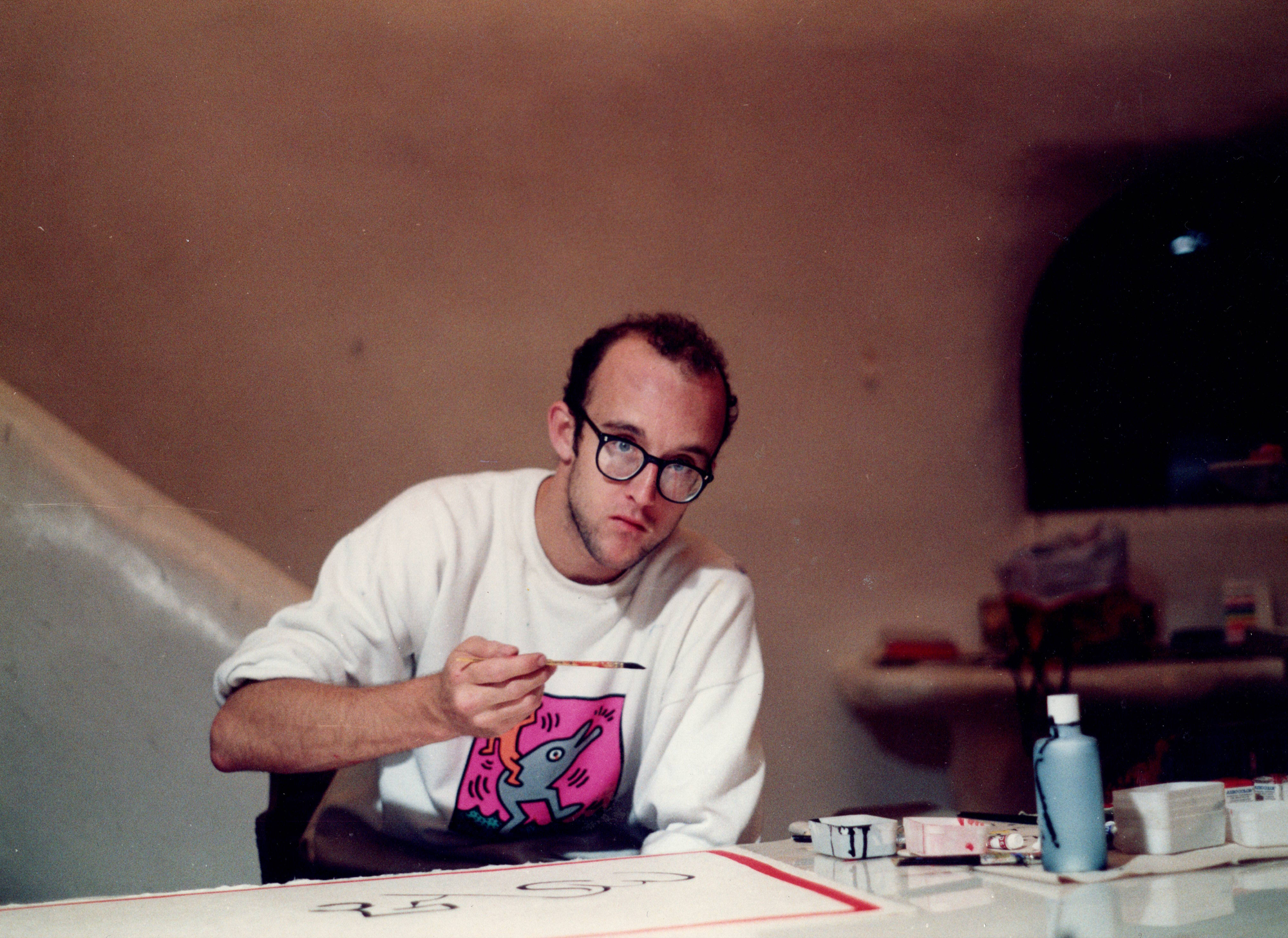
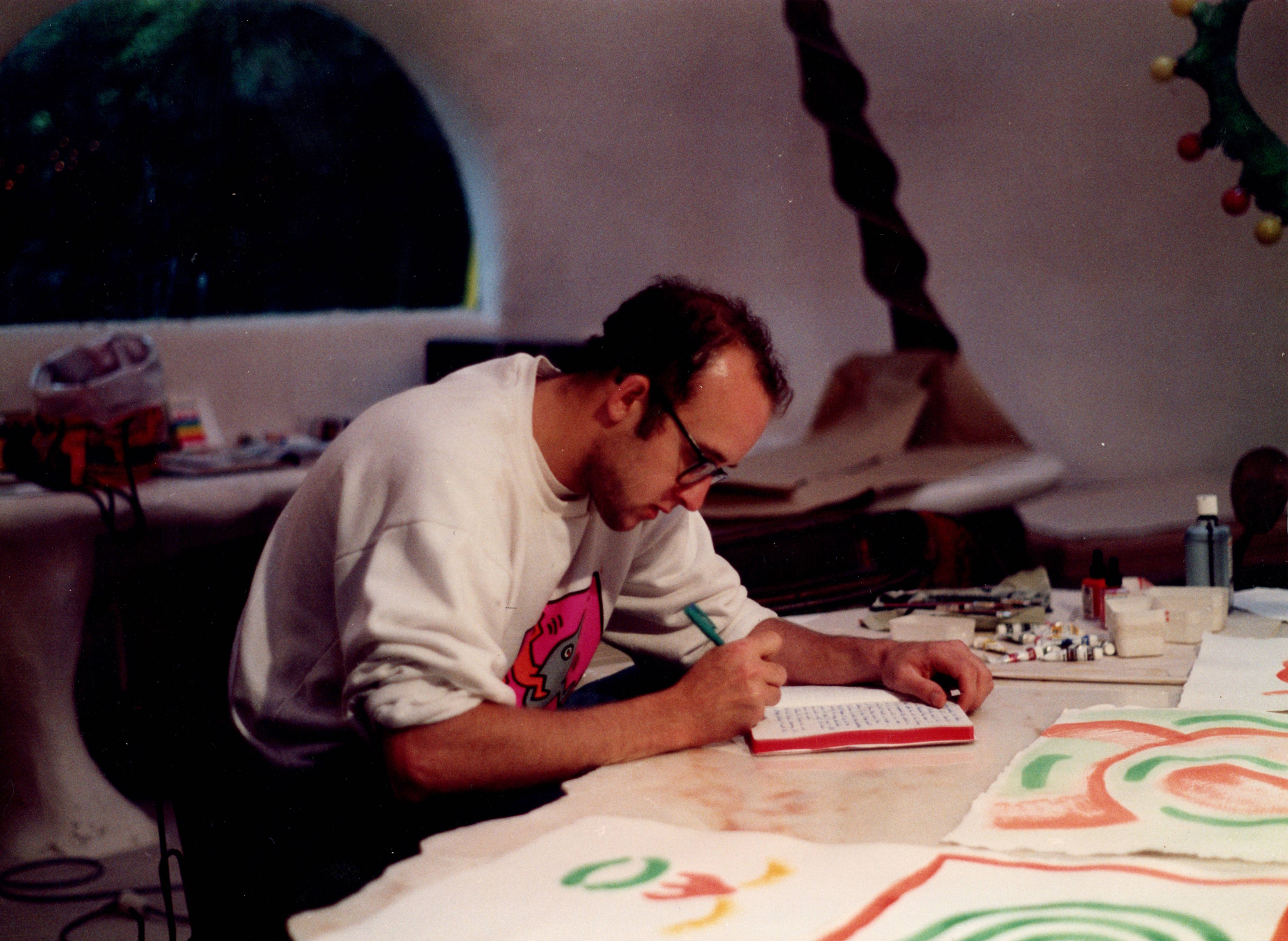
Keith Haring working in Knokke in Le Dragon by Niki De Saint Phalle (1987)
Do you still have visual memories from that period?
We are looking for small and large traces from 1987 or the years surrounding it, including:
Personal memories of Keith Haring in Antwerp, Knokke, or the M HKA.
Stories about visits to Gallery 121, Casino Knokke, the surf club, or other relevant places from that period.
Photos, videos, contact prints, Polaroids, or scans.
Letters, invitations, posters, press clippings, notes, or documentation.
Objects or ephemera with a clear link to Keith Haring, Antwerp, Knokke, or the network of that time.
Names of people we should definitely speak to or contact.
-
In the opening year of the Museum of Contemporary Art Antwerp, Keith Haring created a mural in the museum. During that same period, he was also in Antwerp and Knokke, through exhibitions, encounters, and a network of gallery owners, artists, collectors, friends, and chance witnesses.
Much of that story lives on today not only in archives, but also in personal memories or a small visual memory that was never shared publicly. With this project, M HKA and PLUS-ONE Projects aim to bring those traces together as the starting point for a broader investigation into Keith Haring in Antwerp and Knokke, and into the significance of that period within his practice and in reflection up to the present day.
-
For this research project, M HKA and PLUS-ONE Projects are collaborating to map all of this. M HKA provides the institutional and historical context of the museum, while PLUS-ONE Projects contributes to research, network activation, storytelling, and the tracing of private and public traces that can deepen this narrative.
The collaboration stems from a simple conviction: some art histories live not only in collections and catalogues, but also in people. That is precisely why personal memories, oral testimonies, and visual material are not peripheral information, but an essential part of the research. After all, that is an essential part of Keith Haring's artistic practice.
-
The period around 1987 is historically significant for the M HKA, for Antwerp, and for the bond between Keith Haring and Belgium. At the same time, it is also a moment for which many direct witnesses can still be reached, though not endlessly.
This is therefore not a casual nostalgic appeal, but an initial screening for a carefully constructed process. We are seeking material that can help verify facts, better understand stories, and make the social, artistic, and urban context of those years visible once again.
-
It started in 1987, in the old KNS theatre in Antwerp, during a recording of the Belgian television programme Het Eiland. Keith Haring was a guest, and on the backdrop behind him, the Radiant Baby glowed. I was sitting in the audience next to Juan, wearing my Jazz Montreux t-shirt, one of only two young people in a theatre full of serious faces. From the moment he appeared, I was captured. There was a warmth, an energy, a way of being that was unlike anything I had encountered before.
At the end of the recording, I introduced myself, a nervous young admirer, unsure of what to expect. There was no need to be nervous. What I found was warmth and calm, completely disarming. A few weeks later, I found myself at the Casino in Knokke, part of the world around his exhibition there. I wasn't really helping, I was simply present, going with the flow. That was enough. That was the invitation he extended to people.
After the opening of Gallery 121 in Antwerp, I was included at the dinner table, alongside collectors, gallerists, major figures. I was seventeen. I didn't fully understand who I was sitting next to. That was perhaps the point. Keith made no distinction. He pulled people in, young, unknown, unimportant by conventional standards, and made them feel entirely welcome. That generosity was not a gesture. It was simply who he was.
This is not my story. I was one of many drawn into Keith's orbit during those years in Antwerp, Knokke, New York, Paris, and Düsseldorf. But I was a witness to something that has stayed with me for almost forty years: the rare, genuine openness of an artist who believed that art belonged to everyone, and who lived that belief every single day.
That is why this project matters. Not to tell my story, but to capture, before it fades, the collective memory of what it felt like to be in his presence, and what that presence meant for a city, a museum, and a generation.
Jason Poirier dit Caulier, PLUS-ONE Projects & A.P./ Studio
-
It didn’t begin in a museum gallery or an art book, but in a friendship that appeared almost by chance and ended up shifting my life for good. We were in the eighties, a time when, as a young guy from Ghent, I was discovering my own universe: graffiti on walls, breakdancers on squares, hip-hop records that travelled from New York all the way to us. That culture felt like a new language, raw and direct, and Keith Haring fit into it seamlessly, an artist who seemed made of the same energy and at the same time a person unlike anyone I had met before. What first felt like a single encounter became a whole world opening up, a world in which drawing and living could no longer be separated.
Keith had friends like Madonna and Andy Warhol, but in his diary he wrote that his two biggest fans lived in Belgium. That line has never left me, not because I’m proud of it, but because it shows how closely he paid attention, how precisely he saw people. I was one of those two. I wasn’t a famous collector, nor an influential curator. I was just David, a young guy hungry for images, music and stories. And yet I was fully inside his orbit, as if it were the most natural thing in the world.
In Paris, New York, Ghent and Antwerp I learned that his line was not just a visual form, but an attitude. He drew on walls, on jackets, on paper, but just as much on the lives of the people around him. He took me to places where art and nightlife flowed into one another, where a drawing could appear on a napkin or a T-shirt, and where there was no boundary between the studio and the street. What I saw there was a radical kind of naturalness: art was not meant to be locked away, it had to circulate, stick, move.
We shared moments that now almost feel mythical: a wedding where Madonna and Warhol were simply guests, a city where a new mural appeared like a message addressed to everyone. But the real weight didn’t lie in the names. It lay in the small gestures: the way he listened, the time he took, the invitation to come closer, even when you didn’t yet know what you were there for. Keith made the impossible feel normal: he treated me, and so many others, as if we were naturally part of his story.
This is not my story alone. It is one of many paths that were bent by his presence in those years, in Belgium and far beyond. I witnessed how his work in Knokke, in Antwerp, in New York transformed not only spaces, but also the people moving through them. For a generation of artists, designers, musicians and collectors in Belgium, he was a catalyst, proof that from here you could be part of a global cross-pollination.
Almost forty years later, I still carry that experience with me. Not as nostalgia, but as a task. The openness I felt in him, his belief that art was for everyone and that friendship could be a form of practice, has remained the compass for how I work and live myself. That is why this project matters: not to repeat a myth, but to capture, before it fades, what it was like to be seen by him, and what that gaze has meant for my city, my generation and the way we still look at art today.
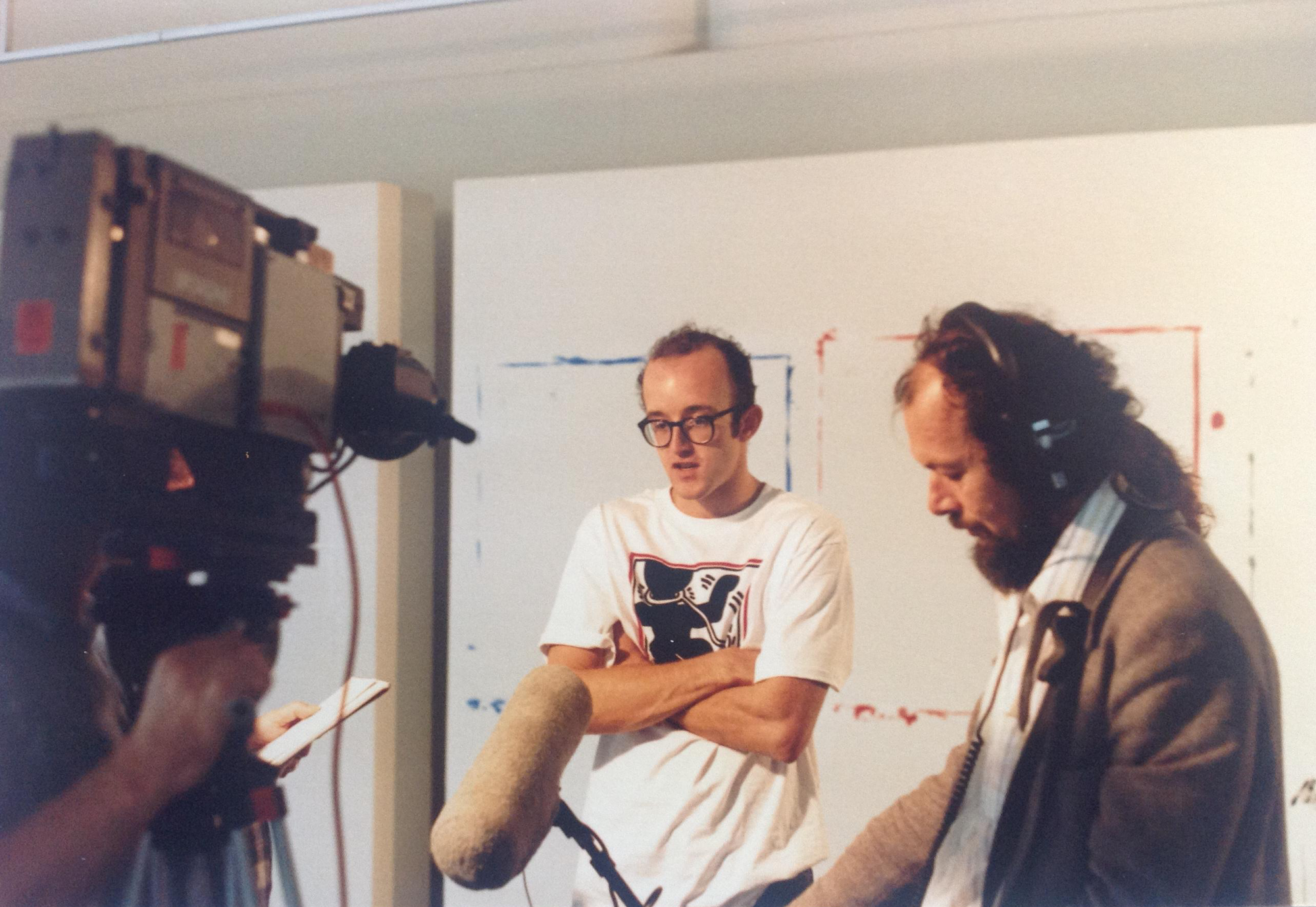
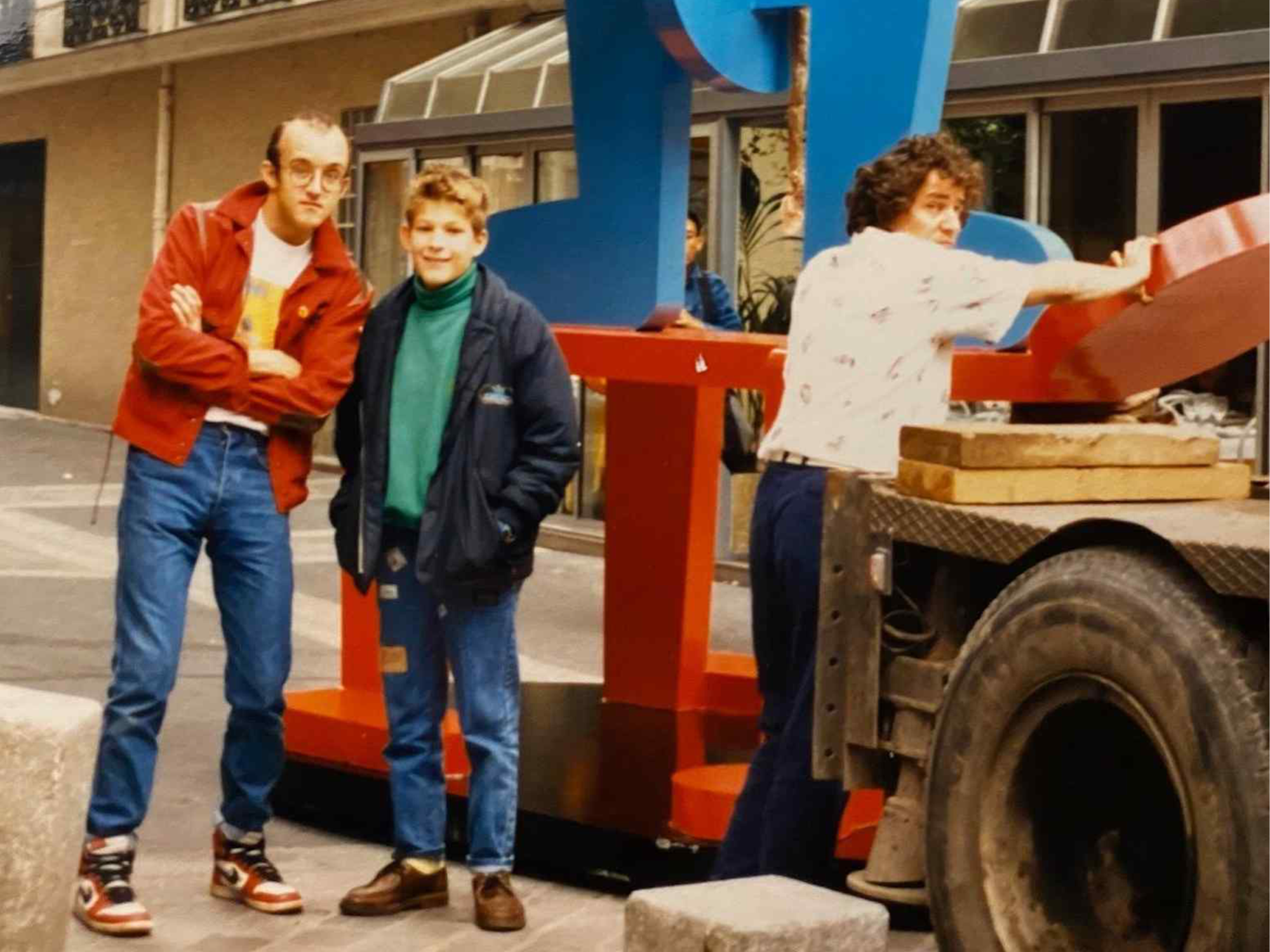
Keith Haring giving an interview in Knokke (1987)
Small memories are also welcome.
Perhaps you don't have a “big story”, but you do have a single photo, a name, a detail, a brief encounter, or a memory of a place or moment. Just such fragments can help to better reconstruct the larger story.
What happens to your submission?
All submissions are first read and reviewed as part of an initial screening within the research process. Not every submission will be used or displayed publicly, but every relevant contribution can help establish connections, locate witnesses, or better interpret historical material.
If you share material, we will review with you what is possible regarding contact, further documentation, use, attribution, and potential follow-up. Authentic objects and documents are always handled in the research with the necessary care and attention to provenance, context, and verification.
Share your story or memory
Were you involved with, present at, or near Keith Haring in Antwerp, Knokke, or the M HKA in 1987 or the years surrounding it? Do you have a story, a memory, a photo, a document, or an object that might be relevant? Leave your details and your contribution below.
We read every submission as part of an initial screening.
-
This is a research project, not an appraisal service. We do not make statements about the authenticity, status, or value of objects or works, and we do not issue certificates or estimates.
At this stage, please share photographs and information only; do not send physical items. If we would like to examine your material more closely, we will contact you and arrange it together.
A submission does not automatically mean the material will appear in the exhibition or publication: that happens only in consultation with you, and after a documentation review together with M HKA. -
What happens with your submission
Every submission is read as part of the research. Stories, names, photographs, documents, and references to places or events matter to us as much as objects do; often more, because they reveal connections that would otherwise be lost. Not every submission will be used or shown publicly, and that says nothing about the value of your story.No authentication, no valuation
Neither the research team nor M HKA makes statements about the authenticity, attribution, status, or value of submitted objects or works. We do not issue certificates, expert reports, or estimates, and our response to a submission may not be used or quoted as such.
The Keith Haring Foundation disbanded its authentication committee in September 2012 and no longer reviews works attributed to Keith Haring; no body exists today that can provide such an opinion. If you wish to have an object assessed for the market, we would refer you to an independent specialist of your own choosing.Submitting does not create a right to inclusion
A submission is a contribution to research. It creates no right to inclusion in the exhibition, the publication, or any other presentation, and no right to credit or compensation. Objects and documents are included only in consultation with you and after a documentation review, in which M HKA and the research team assess provenance and context against a fixed standard. That review concerns documentation, not authenticity.Please do not send physical items
At this stage, share photographs, scans, and information through this form only. Do not send or drop off original objects, documents, or works without a prior arrangement. For material we would like to examine more closely, we will agree on a moment and issue a written receipt setting out arrangements for storage, insurance, and return. Without such an arrangement we cannot take responsibility for material that reaches us.Rights and use
Sharing a photograph or scan with us is not permission to publish. If we wish to use material publicly; in the exhibition, a publication, communications, or online, we will ask for your explicit written consent in advance, and agree with you how you wish to be credited. For work by Keith Haring himself, copyright rests with the Keith Haring Foundation: owning a work or document does not carry the right to reproduce it, and every image is submitted for approval in advance. We therefore cannot always guarantee that material may be reproduced, even where you consent to it.Confidentiality
You are welcome to share material confidentially. If you prefer not to be publicly credited, let us know and we will use the information internally as a research lead only. If you would rather we did not associate your name or your material with another person involved, tell us and we will respect that.Care and uncertainty
Provenance, context, and verification are central to this research. Where something cannot be documented, we say so rather than leaving it out or assuming it. Uncertainty is part of the story of this period, and we treat it with the same care as the things we can establish.Personal data
See the existing passage on the processing of your data and our privacy statement.
-
We invite you to participate in this call and to share some personal data with us as part of the preliminary research and development of the exhibition.
We handle your information with care: all data will be treated confidentially, stored securely, and used exclusively internally for the selection and further preparation of the project.
Your data will never be shared with third parties without your consent. If we wish to use certain information later in a more public context (for example, in the form of an exhibition, communication, audience engagement, or documentation), we will ask for your explicit and informed consent in advance. You always have the right to view your data, have it corrected or deleted, and to withdraw your consent.
By submitting your entry, you agree that we may process your personal data as described above and as further explained in our privacy statement.
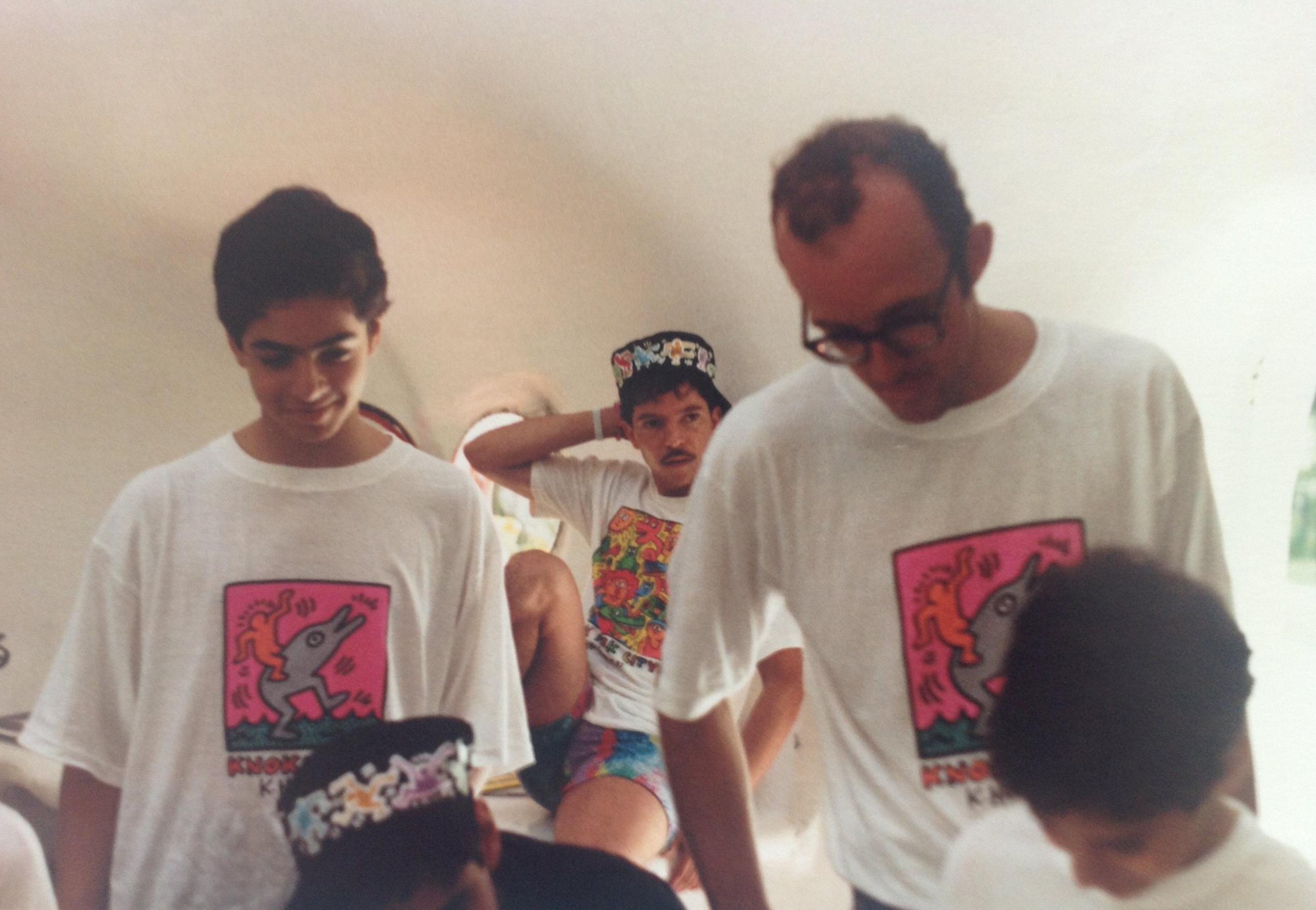
Keith Haring in Knokke in Le Dragon by Niki De Saint Phalle (1987)
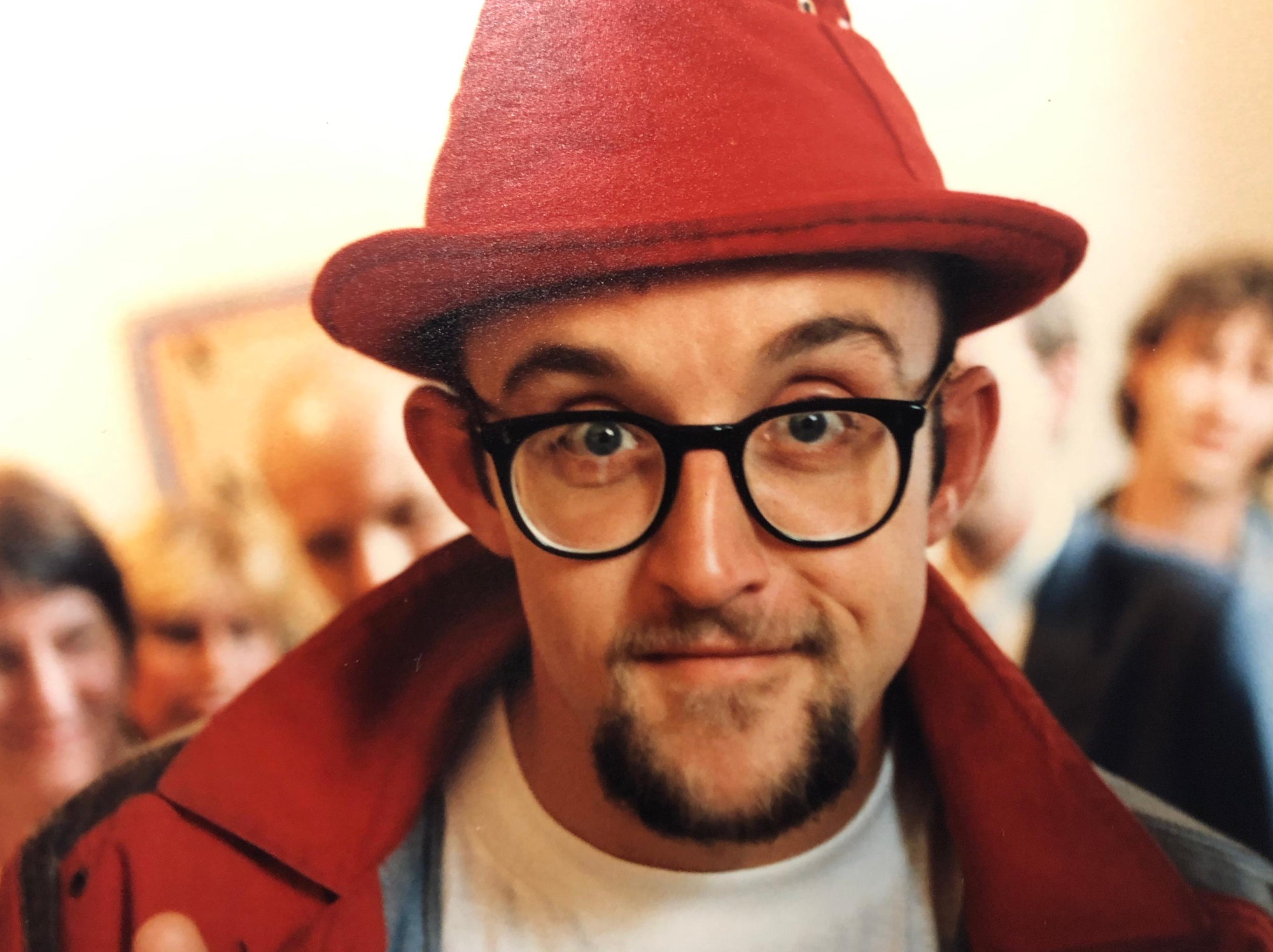
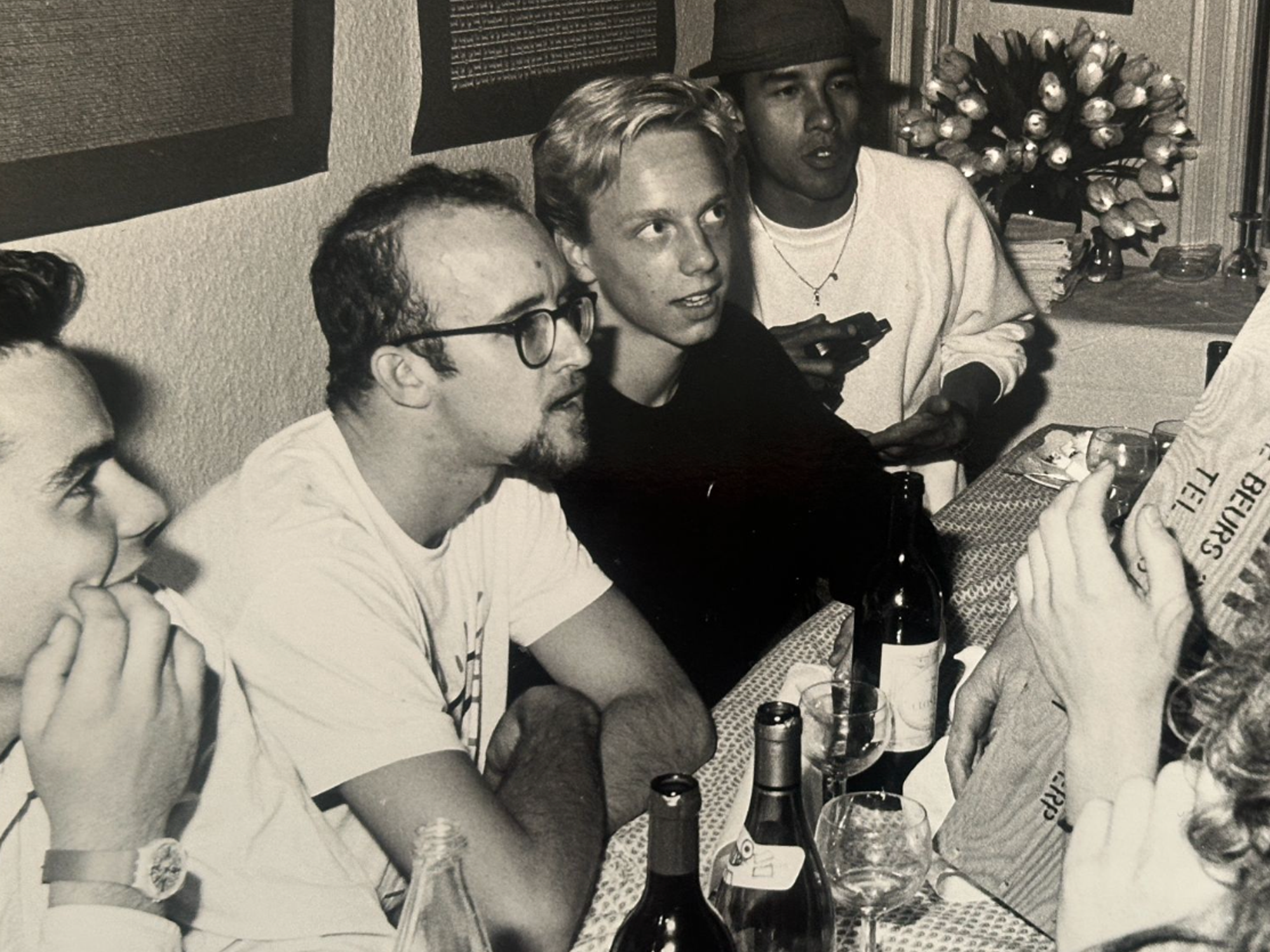
Keith Haring at the opening of his exhibition at Gallery 121 Antwerp (1987)


This preliminary research is a collaboration between M HKA & PLUS-ONE Projects. The pictures on this page come from the archive of © Jason Poirier dit Caulier